Interpreting Combinatorial Circuits: Find the output of each of the following combinatorial circuits.
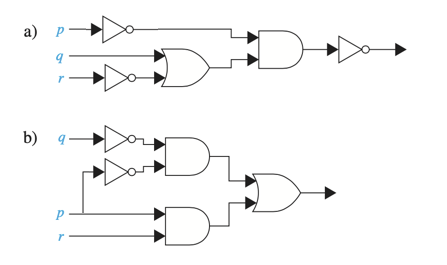
Constructing Combinatorial Circuits: Construct combinatorial circuits from input bits p, q, and r, using inverters, OR gates, and AND gates to produce each of the following outputs.
- (p ∧ q) ∨ (¬ p ∧ r)
- ((¬ p ∧ ¬ q) ∧ r) ∨ ((p ∧ q) ∧ r)
Manipulating Indexed Mathematical Elements:
Section 6.3 presents summation formulae for \( \sum_{i=1}^n i \)
and \( \sum_{i=0}^n r^i \) . A more extensive collection of
summation formulae is available from
this link.
Note that the first of these expressions starts with i=1,
whereas the second begins with i=0!
Although this notation can be convenient when doing mathematics-related work (such as often arises in CS 415, Analysis of Algorithms), use and interpretation of this notation can require some practice. In the following, consider n to be a positive integer, unless otherwise specified.
-
What is the difference in total value between the sums \( \sum_{i=0}^n i \) and \( \sum_{i=1}^n i \) .
-
Use the summation formulae from the book or the above link to find a closed form for \( \sum_{i=1}^5 i \).
-
Use the summation formulae from the book or the above link to find a closed form for \( \sum_{i=1}^{25} i \).
-
Use the summation formulae from the book or the above link to find a closed form for \( \sum_{i=1}^n i \) .
Show that your answer to this part matches your answer from part b, when n=5. -
Use the summation formulae from the book or the above link to find a closed form for \( \sum_{i=1}^{n^2} i \) .
Show that your answer to this part matches your answer from part c, when n=5. -
Use the summation formulae from the above link to find a closed form for \( \sum_{i=1}^{n} i^3 \) .
-
Use the summation formulae from the above link to find a closed form for \( \sum_{j=1}^{k} j^3 \) .
-
Use the summation formulae from the above link to find a closed form for \( \sum_{j=1}^{n^2} j^3 \) .

